Showing posts with label witches. Show all posts

Monday, October 17, 2011

another altered meaning…

feminine… mid-14c., "of the female sex," from O.Fr. femenin (12c.) "feminine, female; with feminine qualities, effeminate," from L. femininus "feminine" (in the grammatical sense at first), from femina "woman, female," lit. "she who suckles," from base of felare "to suck, suckle" (see fecund). Sense of "woman-like, proper to or characteristic of women" is recorded from mid-15c. The interplay of meanings now represented in female, feminine, and effeminate, and the attempt to make them clear and separate, has led to many coinages: feminitude (1878); feminile “feminine” (1640s); feminility “womanliness” (1838); femality (17c., “effeminacy;” 1754 “female nature”). Also feminality (1640s, “quality or state of being female”), from rare adj. feminal (late 14c.), from O.Fr. feminal. And femineity “quality or state of being feminine,” from L. femineus “of a woman, pertaining to a woman.” ... from online etymology dictionary

definitely a female word - ‘of the female sex’ - therefore you would assume that no womon can fail to be feminine, no matter what she looks like, how she dresses or how she asserts herself…

so when did it become 'watered down' and interchangeable with ‘ladylike’ (a word i don't 'subscribe' to - you can read my post ‘this womon ain’t no lady’ here) – hmm, it appears to have started changing in the 15th century when we see the words "proper to .. women" creep into the definition... a time when womyn's worth and their roles were being redefined by a misogynistic, patriarchal culture to keep them subservient and silent - you know, seen but not heard… 

because if you were heard, that meant you had opinions of your own - you may just have been a strong womon... and strong womyn were to be feared...

yes, you may have picked up that the 'shift' in the meaning appears to coincide with the growing fervour of the european witch hunts and hatred of all things female, the gathering momentum with the publication of the malleus malificarum in 1487 and the spreading of fear into england...

and henry (yeah, that one - the 8th!!) 'fed the growing fear' when he accused anne boleyn of witchcraft, infidelity and incest - as adultery was considered treason for a queen it was also a very expedient way to dispose of a womon who'd only 'produced' a daughter - elizabeth - but no sons!... 6 years after her execution henry passed the witchcraft act of 1542 against 'conjurations and wichescraftes and sorcery and enchantmentes.'... the act was repealed in 1547 under edward's reign (but he was only 9 so the regency council was making all the decisions at this time!)

alas, repeal only lasted until the elizabethan witchcraft act was passed during elizabeth's reign in 1562 - sad considering her own mother had been accused of being a witch... but then lizzie had very powerful men with vested interests surrounding and advising her, and she inherited (and maintained) an extremely misogynistic 'kingdom'...  "during the Elizabethan era men were all-powerful. Women had few rights and were expected to obey men. Elizabethan women totally relied on the male members of the family. Society and the culture of England was changing. The convents had been closed. The number of poor was increasing and people were far less charitable. Old, poor, unprotected women needed to be supported - and this was resented by other Elizabethans."

so womyn were either witch - non-submissive, old, poor or without male support in a male dominant society - or submissive - totally downtrodden in a male dominant society - the new vision of feminine...

"the english language has been literally man made and it is still primarily under male control, this monopoly over language is one the means by which males have ensured their own primacy, and consequently have ensured the invisibility or 'other' nature of females, and this primacy is perpetuated while women continue to use, unchanged, the language we have inherited" ... excerpt from dale spender's 'man made language'

what's sad now is when I hear womyn labelling themselves with this diminished patriarchal sense of the word as though being a submissive ‘decoration’ is something to aspire to... and then there's the judgement of others - i'm sure you've all heard someone comment on the perceived feminine or unfeminine 'quality' of someone  - maybe you've heard something similar to "she's as rough as ..., so unfeminine" - or the seal of approval that goes along the lines of "doesn't she look feminine in that"?

perhaps next time you hear that you might think 'hey, she's female - she can't be anything but feminine!' - because to be feminine is to be female... to be female is to be feminine - and strong, and loud and proud - it's a womon-centred word... it's a word worth reclaiming...

Sunday, June 6, 2010

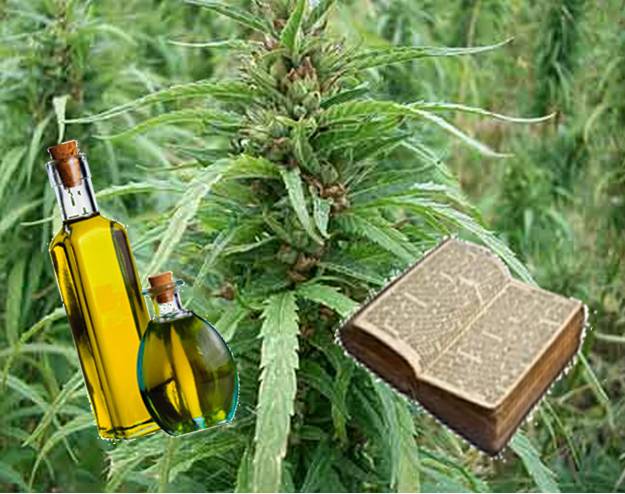
wise womyn and the wondrous weed...

little did i know that sitting down to read my latest edition of the NORML newsletter today would take me on a journey back through centuries of herstory to the christian inquisition...

i started with the article "Latest Research On Pot and Schizophrenia Runs Contrary to Mainstream Media Hype", moved on to "Marijuana Prohibition Corrupts; Absolute Marijuana Prohibition Corrupts Absolutely", read a few more articles, checked out the NORML Women's Alliance page and then ventured over to the site "mums for marijuana" where i watched this very interesting video:


that then led me to more research and the most interesting (and stimulating) reading of the day -the use of cannabis by womyn throughout the centuries - and the outlawing of it by the catholic church...

"During Europe's dark ages, pagan herbalists and witches - mostly women - used cannabis in their ointments and cures. During a time when illness was equated with evil, these pagans attracted a devout following for their miraculous healing lore.

The Catholic Church, threatened by the resurgence of ancient religions and by forms of medicine that challenged their exclusive right to perform healings, gruesomely tortured these women to extract confessions of supposedly satanic allegiance, and then burned them to death in public forums.

Cannabis was a common feature of pagan fertility celebrations in the first 1000 years AD. Like Ostara, the love goddesses Freya and Venus were also often worshipped with cannabis offerings.

Pagan healers, mostly wise women, used cannabis for a number of medicinal benefits. Curiously, some of the earliest evidence of medical-cannabis using pagans comes from the writings of famous Catholic nun and herbalist Hildegard von Bingen of Germany (1098-1179). Hildegard's self-education included ancient Greek medicine and local pagan folk remedies. From her education with pagan wise women, she learned of cannabis' healing powers. In her famous work Physia, in an entry titled "Of Hemp", she writes that "hemp is warm - it is wholesome for healthy people to eat - it can be easily digested, and it diminishes the bad humours and makes the good humours strong."

Curiously, Hildegard also wrote poetry to the "Green Power," and had strong visions, similar to Joan of Arc, who was accused of using the psychedelic mandrake plant and then burned as a witch. Hildegard von Bingen's unprecedented influence on the early German pharmacopoeia ensured that cannabis remedies would eventually become common across Europe - especially as the terrors of the Black Death crept up from European sewers and into the homes of millions, making the purveyors of mainstream medicine seem like helpless fools."... you can read more at cannabis culture


i did a bit more reading and came across a few references to a book called "The emperor wears no clothes" by Jack Herer, an american cannabis activist... and discovered the book online on his website... the following excerpt is from chapter 10 -  "Myth, Magic & Medicine: A Look at the Sociology of Cannabis Use Throughout World History"...

"From at least the 27th century B.C. up until this century, cannabis was incorporated into virtually all the cultures of the Middle East, Asia Minor, India, China, Japan, Europe, and Africa for its superior fiber, medicines, oils, food and for its meditative, euphoric, and relaxational uses.

Hemp medicine was found effective as wound healer, muscle relaxant, pain reliever, fever reducer and unparalleled aid to childbirth, not to mention hundreds of other medicinal applications.

Hemp was a major industry in biblical times. As in other cultures throughout the Middle East, the Hebrew tradition of mysticism (e.g., Cabala) was aware of, and entwined with, regional sects using natural intoxicants in their rituals. As usual, they hid this knowledge behind rituals, symbols and secret codes to protect natural sacraments like “sacred mushrooms” and mind-elevating herbs, including cannabis."

With constantine’s eventual (strategic) conversion to Christianity – hence the merging of church and state – "in the 4th, 5th and 6th centuries A.D., pagan religions and all the different Christian sects, belief systems, knowledge, gospels, etc., such as the Essenes, Gnostics and Merovingians (Franks), were either incorporated into or edited out of official doctrine and hierarchy.

Finally, in a series of councils, all contrary dogmas (e.g., that the Earth was round, and the sun and stars were more than five to 17 miles away) were summarily outlawed and driven underground during the Dark Ages, 400 -1000+ A.D.

By the early Middle Ages, at the beginning of the 11th century A.D., virtually all powers were placed in the hands of the Church and Pope" - the divine right to rule had become their dogma and the pope had become infallible!!!!

"To prohibit knowledge, people were literally kept in the dark, without a piece of paper to write on. The monasteries preserved and guarded hemp’s secrets. They saw that cannabis held two threats to this policy of absolute control: papermaking and lamp oil.

While embracing wine as a sacrament, and tolerating beer and hard liquor, the Inquisition outlawed cannabis ingestion in Spain in the 12th century, and France in the 13th. Many other natural remedies were simultaneously banned. Anyone using hemp to communicate, heal, etc. was labeled “witch.”

Virtually the only legal medical cures allowed the people of Western Europe by the Roman Catholic Church Fathers at this time were:

1. (a.) Wearing a bird mask for plague. (b.) Setting fractured bones or cleaning burns.

2. Bleeding pints and even quarts of blood from all flu, pneumonia or fever patients (victims) which was the most used treatment in Europe and America by doctors until the beginning of the 1900s. It does not work! And did not work no matter how much blood they took.

3. Praying to specific saints for a miraculous cure, e.g., St. Anthony for ergotism (poisoning), St. Odilla for blindness, St. Benedict for poison sufferers, and St. Vitus for comedians and epileptics.

4. Alcohol for a variety of problems.

Saint Joan of Arc, for example, was accused in 1430-31 of using a variety of herbal “witch” drugs, including cannabis, to hear voices.

In 1484, Pope Innocent VIII singled out cannabis healers and other herbalists, proclaiming hemp an unholy sacrament of the second and third types of Satanic mass. This persecution lasted for more than 150 years. Satanic knowledge and masses, according to the Medieval Church, came in three types:

• To summon or worship Satan;

• To have Witch’s knowledge (e.g., herbalists or chemists) of making, using or giving others any unguent or preparation including cannabis as medicine or as a spiritual sacrament;

• The Mass of the Travesty - doing irreverent, farcical or satirical take-offs on the dogmas, doctrines, indulgences, and rituals of the R.C.Ch. mass and/or its absolute beliefs.

Because medieval priest bureaucrats thought they were sometimes laughed at, ridiculed and scorned by those under their influence - often by the most learned monks, clerics and leading citizens - ingesting cannabis was proclaimed heretical and Satanic.

For cannabis-related knowledge, or hundreds of other “sins” - owning a devil’s tool (dinner fork), reading a sorcerer’s book or speaking in tongues (foreign language), having a different faith, having the witch’s habit (taking a bath or falling into a river), etc. - from 10% to as many as 50% of the people in Western Europe were tortured or put to death without trial during the medieval Roman Catholic Church’s 500-year Inquisition (12th to 17th centuries).

The Pope could declare anything “heresy,” and use it as an excuse to legally rob, torture and kill his enemies or anyone else accused. For over 300 years, inquisitors divided up the property forfeited to them by suspected witches and heretics. Whoever denounced you got 1/3 of your property, 1/3 went to the government and 1/3 went to the Papal hierarchy."

the government and church definitely had a vested interest in whipping up a frenzy of fear... and what an incentive - accuse or be accused!!!! fear compels some to do terrible things - and fear always reigned... poverty could be alleviated by an accusation – greed could be rewarded - jealousies could be assuaged and competition could be gotten rid of - of course the worst atrocities were brutally perpetrated by the witch-hunters, who could satisfy their misogynistic and sadistic desires through terrible tortures, with suffering and death the result... it's estimated that anywhere from hundreds of thousands, to millions, of womyn died - but no matter the exact number, it was without a doubt a holocaust...


a little bit more reading enlightened me to the fact that Bast is the most important "goddess of cannabis witchcraft"...


"Bast, or Bastet, is one of the oldest of the Kemetic neteru (egyptian deities). The city of Per-Bastet, capital of the Am Khent sepat (or state), was dedicated to the worship of Bast. Bast is a very complex and complete Goddess. She if often described as the Goddess of cats and usually depicted as a beautiful human woman with the head of a cat. She is also the Goddess of cannabis and every cannabis plant is a physical embodiment of Bast. All followers of Am Khent Kemeticism are required by their religion to honor Bast, cats, and cannabis.


The Greeks called this same Goddess Artemis, one of the most widely venerated of the Ancient Greek deities. Some scholars believe that the name, and indeed the goddess herself, was originally pre-Greek.. The Temple of Artemis at Ephesus was one of the seven wonders of the ancient world."


and then there is Diana, the Roman version of the magick Goddess of cannabis, also known as Queen of Witches... "One of the primary goals of the Christian Inquisitions was to stamp out worship of Diana. Some scholars think this was the original reason for the Inquisition. The Christian clergy proclaimed that Diana was the Queen of the Witches. Torquemada, an infamous witchhunter and grand Inquisitor, claimed that Diana was Satan."... she was also called Goddess of the Pagans and the Night Goddess...


you just never know where a newsletter will lead... and now i'm off to partake of the 'witches weed'...

Friday, November 13, 2009

the language of fear...

an abnormal fear of the number 13

paraskevidekatriaphobia (wouldn't want to have to say that in a hurry)...
an abnormal fear of friday the 13th...

are these fears inherently misogynistic?

the number 13 is closely aligned to the moon and the menses - it's the number of lunar cycles, the number of menstrual cycles, in a solar year... a number intimately connected with womanhood...

christian fear of pagan female deities, fear and hatred of the female body, and the persecution of strong, independent women created an anti-pagan, anti-woman fervour, hence the original word for the fear of both friday and 13...

friggatriskaidekaphobia...
from Frigga (Norse goddess associated with Friday) + triskaidekaphobia (fear of the number 13)

"Frigga (also known as Frigg, The Beloved) was the goddess of love, marriage, and destiny. She was the wife of the powerful Norse god Odin, The All-Father.

A sky goddess, responsible for weaving the clouds (and therefore for sunshine and rain and the fertility of the crops), she was also responsible for weaving the fates. She was known as a 'seer', one who knew the future though she could never change it."
the goddess gift website


"Friday is Frigga's Day. Frigga (Frigg) was an ancient Scandinavian fertility and love goddess, equivalent to the Roman Venus who had been worshipped on the sixth day of the week. Christians called Frigga a witch and Friday the witches' Sabbath." the skeptic's dictionary

"When Norse and Germanic tribes converted to Christianity, Frigga was banished in shame to a mountaintop and labeled a witch. It was believed that every Friday, the spiteful goddess convened a meeting with eleven other witches, plus the devil - a gathering of thirteen - and plotted ill turns of fate for the coming week..."
wikipedia

according to the article "The church, a witch, sex and satan: oppressing witches: symbolic of oppressing women's sexuality" "the christian concept of "evil" has long been synonymous with sexual desire and the rejection of women in general and women's sexuality in particular."

from an article entitled "hammer time: portrayal of witches, witchcraft and medieval christianity" "it is amazing how celibate men became obsessed with the sexuality of women. as it is stated in malleus malificarum: all witchcraft comes from carnal lust, which is, in women, insatiable."

the infamous 'malleus malificarum' (the witches' hammer) became the torturer's bible, and Nancy van Vuuren in "The subversion of women as practiced by churches, witch hunters and other sexists" states "...the women's sex organs provided special attraction for the male torturer".


black cats have long been associated with friday the 13th and the feminine - they were seen as the familiars of witches - wise women and healers - but the rise of christian 'hysteria' introduced the concept of witches' pets as evil, and agents of the devil


the number 13, religious intolerance, persecution, and fanatacism, the subversion of women - fascinating topics which deserve to be explored more thoroughly... but that'll have to wait for another day...


Photobucket
hope you had a wonderful friday the 13th!!!


Thursday, October 30, 2008

a christian corruption of a Celtic belief?

Halloween was a topic for conversation at work today... not something we really celebrate here in Australia... with good reason!!!!


"Samhain became the Halloween we are familiar with when Christian missionaries attempted to change the religious practices of the Celtic people. In the early centuries of the first millennium A.D., before missionaries such as St. Patrick and St. Columcille converted them to Christianity, the Celts practiced an elaborate religion through their priestly caste, the Druids, who were priests, poets, scientists and scholars all at once. As religious leaders, ritual specialists, and bearers of learning, the Druids were not unlike the very missionaries and monks who were to Christianize their people and brand them evil devil worshippers.

As a result of their efforts to wipe out "pagan" holidays, such as Samhain, the Christians succeeded in effecting major transformations in it. In 601 A.D. Pope Gregory the First issued a now famous edict to his missionaries concerning the native beliefs and customs of the peoples he hoped to convert. Rather than try to obliterate native peoples' customs and beliefs, the pope instructed his missionaries to use them: if a group of people worshipped a tree, rather than cut it down, he advised them to consecrate it to Christ and allow its continued worship.

In terms of spreading Christianity, this was a brilliant concept and it became a basic approach used in Catholic missionary work. Church holy days were purposely set to coincide with native holy days. Christmas, for instance, was assigned the arbitrary date of December 25th because it corresponded with the mid-winter celebration of many peoples. Likewise, St. John's Day was set on the summer solstice..."
read the article here


and not only is it a christian corruption, it's an american commercialization of a christian corruption!!!!


"The imagery surrounding Halloween is largely an amalgamation of the Halloween season itself, nearly a century of work from American filmmakers and graphic artists, and a rather commercialized take on the dark and mysterious. Halloween imagery tends to involve death, magic, or mythical monsters. Traditional characters include... witches, owls, crows, vultures, pumpkin-men, black cats, spiders...


Particularly in America, symbolism is inspired by classic horror films, which contain fictional figures like Frankenstein's monster and The Mummy. Elements of the autumn season, such as pumpkins and scarecrows, are also prevalent. Homes are often decorated with these types of symbols around Halloween..." Wikipedia


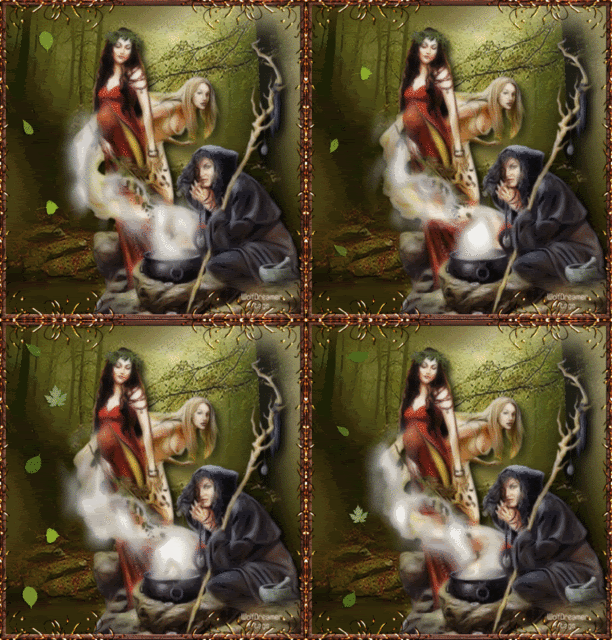
I hate this graphic depiction of wise women (aka witches)...

the old decrepit hag,

or the mysterious woman


(I have to put this in here - from an earlier post - THE WITCH / WISE WOMAN

“Women have always been healers. They were the unlicensed doctors and anatomists of western history. They were abortionists, nurses and counselors. They were pharmacists, cultivating healing herbs and exchanging the secrets of their uses. They were mid-wives, traveling from home to home and village to village. For centuries women were doctors without degrees, barred from books and lectures, learning from each other, and passing on experience from neighbour to neighbour and mother to daughter. They were called “wise women” by the people, witches or charlatans but the authorities.” .. Witches, midwives & nurses: a history of women healers


they were ALL of these - healers, midwives - oooooh, dare I say doctors - AND sensual beings, sexual beings - they were WOMEN / WOMYN / WOMIN!!!!!


Unfortunately this was the reality of the 'witch-hunts' - women slaughtered!!!!

This is Bridget Bishop's hanging - check out some shit about her... she was a strong woman, and oooooh, apparently sensual and sexual - a no-no in a patriarchal misogynistic world!!!!!

today she'd be called slut, whore, (another older post - the politics of language).....


or read about Eunice "Goody" Cole - the "Witch Of Hampton" ....
.... i'm a tad bewildered by the acceptance of this crap and the depiction and acceptance of women as ugly, evil - those fucking frightening creatures - witches, (midwives and nurses) -- the slaughter of our sisters - and sympathetic brothers... guess I'm sick of patriarchal shit, american garbage... if you 'play' along with it, you never change it, you just accept it!!!!


.... I'm pretty sure I'll be coming back to this post soon....


Sunday, September 30, 2007

More graphics / image generators

SMILEBOX PHOTO SHARING


Now this could be a fun application… make your own scrapbooks, slideshows, greeting cards, photo albums, invitations, postcards… haven’t checked all of it out yet, but it definitely looks like it has potential… unfortunately you do have to download the program to the hard drive – but if you’re able to then it’s well worth checking out… one of its drawbacks is the time it takes for the pages to load when viewing… there’s always compromise!!!!

WOMEN WARRIORS THROUGH THE AGES

Warrior women
Powered by Smilebox
Click to play Make your own Smilebox

There's a rich herstory of women warriors, rulers, amazons, samurai, pirates, buccaneers, crusaders - women had to fight for their beliefs and survival in their own way in a patriarchal society (and things haven't changed!!) - here's just a small selection of graphics I put together.

Here's a few sites to check out if you're interested in the background herstory of some of these women...

Women Warriors of Japan

Pirates

Amazons

Women in world history

Saturday, September 22, 2007

Still playing around with Flickr...

... but I don't find it's 'toys' very user friendly programmes - maybe that's just me??

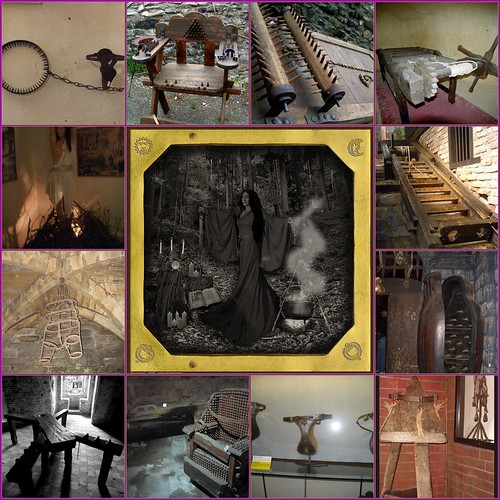
THE WITCH-HUNTER'S TOOLS OF TORTURE

Haven't been able to work out if you can include a slideshow in the blog or not, so have done another montage of the tools of torture used against wise women - well, any women actually. You also weren't immune if you were a male sympathiser. More to come on the church's attempted annihilation of women soon.

1. the sorceress, 2. Torture implement and Chastity Belt, Witchcraft and Inquisition Museum, Ronda, 3. Torture, 4. Estica-estica, 5. Matera rack, 6. www.flickr.com/photos/scurzuzu/469230395/, 7. A medieval rack, 8. dungeon, 9. Medieval Torture, 10. Silent screams, 11. Torture chair, 12. Rottenburg Medieval Torture Museum, 13. pointy chair

Created with fd's Flickr Toys.

Friday, September 14, 2007

creating the blog...

my venture into the 'blogosphere' started as a work-related training program around web 2.0 technology in 2007... the program lasted 23 weeks where i discovered some of the amazing tools 'out there' and got a good grounding in the basics of blogging...

i'm writing this brief 'introduction' three years down the track...

 my enjoyment in creating and maintaining my blog increased and intensified once i really 'owned' it - when it was no longer a compulsory work task... it's a very stimulating and therapeutic pastime these days... it's an insight into me and my politics and a glimpse into my life - both the pleasure and pain... 


i contemplated deleting all of the earlier 'learning' posts, but decided against that... it was a learning curve for me and someone else might find the information useful... and hey, it's part of my blogging herstory...

so here's how it all began... my first post...
_____________________________________________________________________


Okay, the following has nothing whatsoever to do with libraries or Web 2.0, but as it's the first Post, and creating the blog is all about formatting, fonts, colours etc., a decent body of text was a good way of seeing if that all works, so I hope you find it interesting.


SYMBOLS OF WOMEN’S SUFFRAGE/LIBERATION

WOMEN’S COLOURS
The colours used on this page have specific meaning to women. The colours originated during the Suffrage Movement with the Women’s Social and Political Union (WSPU) in the U.K. in 1908.
The colours were said to represent:
white for purity; purple for dignity, self-reverence and self-respect; and green for hope and new life.
The tricolour of the WSPU soon became a visual cue for the women's movement in Australia. Purple, green and white were worn on International Women's Day and were used for other women's movement banners and posters - although when i was active in the movement in the 70s there was no green involved, it was always purple and white (and consequently they're the 2 colours i associate with womyn and womyn's liberation - but i question the purity association!)

The American Suffrage Movement also adopted these colours but replaced the green with gold.

The use of gold began with Elizabeth Cady Stanton and Susan B. Anthony's campaign to help pass a suffrage state referendum in Kansas in 1867. The Kansas state symbol was the sunflower, which was adopted by the pro suffrage forces in the campaign. The sunflower, and the color gold or yellow, was associated with the suffrage cause thereafter. Suffrage supporters used gold pins, ribbons, sashes, and yellow roses to denote their cause.

THE WITCH / WISE WOMAN
“Women have always been healers. They were the unlicensed doctors and anatomists of western history. They were abortionists, nurses and counselors. They were pharmacists, cultivating healing herbs and exchanging the secrets of their uses. They were mid-wives, traveling from home to home and village to village. For centuries women were doctors without degrees, barred from books and lectures, learning from each other, and passing on experience from neighbour to neighbour and mother to daughter. They were called “wise women” by the people, witches or charlatans but the authorities.” .. Witches, midwives & nurses: a history of women healers


THE WOMEN'S SYMBOL

The circle with the cross extending down is the biological female symbol

"The symbol depicting a clenched fist inside the biological female symbol was produced by Robin Morgan for the second Miss America Pageant demonstration, in 1969. It combined the elements of defiance and revolution with that of femaleness. The original version was a dark red on a white background. Initially, Robin Morgan worried over the choice of a red button for this particular demonstration. Ever conscious that major corporations like to co-opt incipient protest movements, she imagined that the cosmetic firm sponsoring the pageant might respond by manufacturing a matching lipstick named "Liberation Red." Therefore, if asked about the button, women were instructed to reply that the color was "Menstrual Red." No one would name a lipstick that" .. Jo Freeman